Title here
Summary here
Version 0.7.0 introduces the Augmentation Function framework, a major feature addition that extends Digital Twin capabilities beyond basic shadowing. This release adds a fully event-driven augmentation layer, comprehensive storage support for augmentation data, new event types on the WLDT Event Bus, and native augmentation-aware callbacks inside the DigitalTwinModel.
Key Updates:
WldtStorage now defines a full set of abstract methods to persist and query augmentation function requests, results, errors, registrations, and unregistrationsWldtEventTypes covering the complete augmentation lifecycle (registration, execution, result, error)DigitalTwinModel Augmentation Integration: The DigitalTwinModel now subscribes to augmentation events automatically and exposes optional callback methods and invocation helpers for both Stateless and Stateful functionsThis release introduces the Augmentation Function framework, a first-class mechanism for extending Digital Twin behaviour with external computation units that operate independently from the shadowing logic.
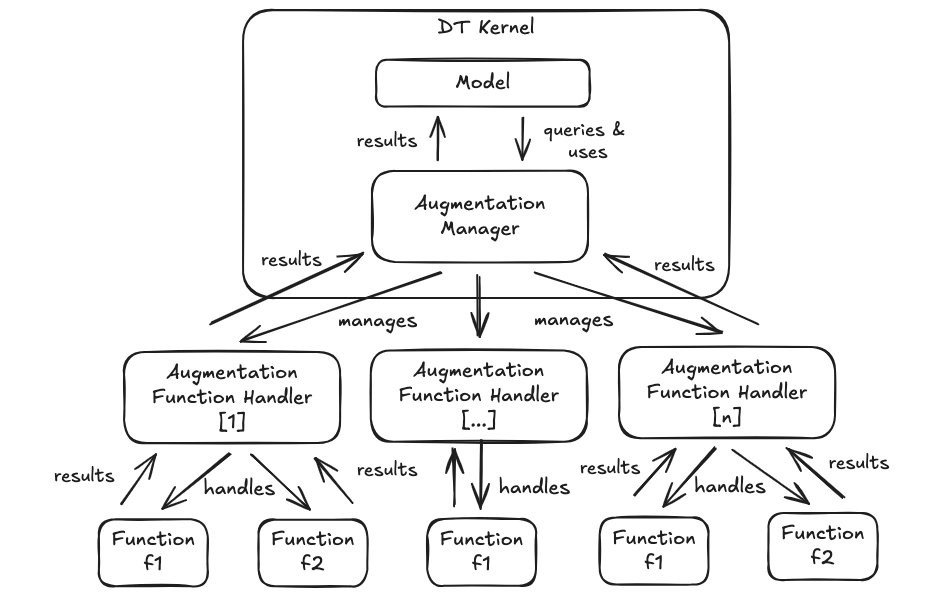
The augmentation architecture is organized in four tiers:
| Tier | Component | Role |
|---|---|---|
| 1 | DT Kernel | Hosts the DigitalTwinModel and the AugmentationManager |
| 2 | AugmentationManager | Central orchestrator; manages handlers, propagates lifecycle events, caps concurrent handlers at 5 |
| 3 | AugmentationFunctionHandler | Manages a group of functions; handles execution, context provisioning, and result forwarding |
| 4 | AugmentationFunction | Performs actual computation (stateless or stateful) |
A Stateless Function does not maintain internal state between invocations. Each execute call is fully independent.
executeAugmentationFunction(...) from the DigitalTwinModelAugmentationFunctionContextRequestTypical use cases: threshold checks, unit conversions, data validation, instantaneous calculations.
A Stateful Function maintains internal state across a continuous execution lifecycle managed through start / stop operations.
startAugmentationFunction(...), stopped via stopAugmentationFunction(...)DigitalTwinState and event notifications while runningonStatefulAugmentationFunctionQueryResultRefreshTypical use cases: pattern recognition, trend analysis, running averages, adaptive AI models.
AugmentationFunctionHandler is the abstract base class for all handlers. The ready-to-use concrete implementation is DefaultAugmentationFunctionHandler:
// Create the handler
DefaultAugmentationFunctionHandler handler = new DefaultAugmentationFunctionHandler("sensor-handler");

// Register functions
handler.registerAugmentationFunction(new MyStatelessFunction());
handler.registerAugmentationFunction(new MyStatefulFunction());

// Attach to the AugmentationManager
DigitalTwin digitalTwin = new DigitalTwin("my-dt-id", new MyDigitalTwinModel());
digitalTwin.getAugmentationManager().addAugmentationFunctionHandler(handler);
Functions can be unregistered at runtime without stopping the handler:
handler.unRegisterAugmentationFunction(MyStatelessFunction.FUNCTION_ID);
Handlers can be removed from the manager entirely:
digitalTwin.getAugmentationManager().removeAugmentationFunctionHandler("sensor-handler");
The augmentation lifecycle follows an event-driven, loosely coupled flow:
DigitalTwinModel subscribes to registration and result events.AugmentationManager to discover already-registered functions and fires the appropriate callbacks.The AugmentationManager is created automatically for each DigitalTwin instance and is accessible via:
AugmentationManager augmentationManager = digitalTwin.getAugmentationManager();
⚠️ Warning: The
AugmentationManagerlimits concurrent handlers to 5. Exceeding this limit throws anAugmentationFunctionException.
Three listener interfaces decouple functions from their handlers:
| Interface | Implemented By | Purpose |
|---|---|---|
AugmentationLifeCycleListener | AugmentationFunctionHandler | Receives relevant DT lifecycle events |
StatelessAugmentationListener | AugmentationFunctionHandler | Receives error notifications from stateless functions |
StatefulAugmentationListener | AugmentationFunctionHandler | Receives results, errors, and query refresh requests from stateful functions |
AugmentationFunctionResult<?>: Carries the output of a function execution together with type metadata (AugmentationFunctionResultType) and optional performance metrics (AugmentationFunctionResultMetrics)AugmentationFunctionError: Carries error information with an associated AugmentationFunctionErrorType, used by both stateless and stateful functions to report failuresAugmentationFunctionContext encapsulates the runtime data provided to a function during execution.
public class AugmentationFunctionContext {
    private DigitalTwinState digitalTwinState;
    private QueryResult<?> queryResult;
}
| Field | Type | Description |
|---|---|---|
digitalTwinState | DigitalTwinState | Current DT state at the time of invocation |
queryResult | QueryResult<?> | Results from storage queries defined in the AugmentationFunctionContextRequest (optional) |
The context is built automatically by the framework and injected into run() (stateless) or start() (stateful) — developers never create it directly.
AugmentationFunctionContextRequest is the configuration that each augmentation function declares to tell the framework what data it needs at runtime. It is typically set once in the function’s constructor.
public class AugmentationFunctionContextRequest {
    private boolean observeState;               // default: true
    private boolean observeEventNotifications;  // default: true
    private List<String> propertyNameFilter;    // null = observe all
    private List<String> eventNameFilter;       // null = observe all
    private List<String> relationshipNameFilter;// null = observe all
    private QueryRequest queryRequest;          // null = no storage query
}
⚠️ Note:
propertyNameFilter,eventNameFilter, andrelationshipNameFilterare declared but currently not enforced by the framework. UseobserveState: falseorobserveEventNotifications: falseto fully suppress the corresponding data stream.
Constructors:
// Default: observes state and events, no storage query
new AugmentationFunctionContextRequest()

// With a storage query only
new AugmentationFunctionContextRequest(QueryRequest queryRequest)

// With explicit observation flags and optional query
new AugmentationFunctionContextRequest(boolean observeState,
                                       boolean observeEventNotifications,
                                       QueryRequest queryRequest)
Example — function that queries the last 10 minutes of DT state history:
public MyStatelessFunction() {
    super("my-fn", "My Function", "Analyzes history", "1.0.0",
          new AugmentationFunctionContextRequest(
              new QueryRequest()
                  .setResourceType(QueryResourceType.DIGITAL_TWIN_STATE)
                  .setRequestType(QueryRequestType.TIME_RANGE)
                  .setStartTimestampMs(System.currentTimeMillis() - 600_000)
                  .setEndTimestampMs(System.currentTimeMillis())
          ));
}
⚠️ Note: timestamps are computed once at construction time. For a truly sliding time window, build and pass a fresh
QueryRequestat each invocation instead.
AugmentationFunctionRequest is the runtime object passed to every lifecycle method (run(), start(), stop()). It bundles the context with invocation metadata.
public class AugmentationFunctionRequest {
    private final String requestId;                // Auto-generated or developer-provided UUID
    private final AugmentationFunctionContext context;
    private final AugmentationFunctionRequestType type; // EXECUTE | START | STOP
    private final Long timestamp;                  // Milliseconds since epoch
}
// Inside run() / start() / stop()
AugmentationFunctionContext ctx  = request.getContext();
DigitalTwinState            state = ctx.getDigitalTwinState();
QueryResult<?>              query = ctx.getQueryResult();
AugmentationFunctionRequestType requestType = request.getType();
AugmentationFunctionRequestType enum:
| Value | Triggered by | Target |
|---|---|---|
EXECUTE | executeAugmentationFunction(...) | Stateless functions |
START | startAugmentationFunction(...) | Stateful functions |
STOP | stopAugmentationFunction(...) | Stateful functions |
| Aspect | Stateless | Stateful |
|---|---|---|
| Context frequency | Once per execute() call | Initial context at start() + runtime updates |
| State updates | Not applicable | Via onStateUpdate() if observeState = true |
| Event notifications | Not applicable | Via onEventNotificationReceived() if observeEventNotifications = true |
| Context refresh | Not possible | Automatic (push) or explicit (polling via refreshQueryResult()) |
| Query execution | Once per execution | Initial + re-triggered on demand |
Every augmentation function produces zero or more results wrapped in AugmentationFunctionResult<T>:
public class AugmentationFunctionResult<T> {
    private AugmentationFunctionResultType type;
    private String key;
    private T value;
    private AugmentationFunctionResultMetrics augmentationFunctionResultMetrics; // optional
    private Map<String, Object> metadata;                                        // optional
    private AugmentationFunctionRequest request;   // set automatically by the handler
    private final Long timestamp;                  // set automatically
}
Constructor:
new AugmentationFunctionResult<>(
    AugmentationFunctionResultType type,
    String key,
    T value,
    AugmentationFunctionResultMetrics metrics,  // null if not needed
    Map<String, Object> metadata                // null if not needed
)
Five result types map to specific Digital Twin components:
| Type | Digital Twin Component | Typical Use Case |
|---|---|---|
PROPERTY_RESULT | DT State Properties | Predicted temperature, derived efficiency metric |
EVENT_RESULT | DT State Events | Anomaly detected, threshold exceeded |
RELATIONSHIP_RESULT | DT State Relationship declarations | New relationship type discovered |
RELATIONSHIP_INSTANCE_RESULT | DT State Relationship instances | Concrete connection to another DT |
GENERIC_RESULT | Model-defined handling | Custom analytics, recommendations |
Example — multi-result production:
List<AugmentationFunctionResult<?>> results = new ArrayList<>();

// Predicted property value
results.add(new AugmentationFunctionResult<>(
    AugmentationFunctionResultType.PROPERTY_RESULT,
    "predicted_failure_probability",
    0.78,
    null,
    Map.of("confidence", 0.92, "horizon_hours", 48)
));

// Event notification
results.add(new AugmentationFunctionResult<>(
    AugmentationFunctionResultType.EVENT_RESULT,
    "maintenance_required",
    Map.of("urgency", "HIGH"),
    null,
    Map.of("timestamp", System.currentTimeMillis())
));

// Generic analytics
results.add(new AugmentationFunctionResult<>(
    AugmentationFunctionResultType.GENERIC_RESULT,
    "degradation_analysis",
    Map.of("trend", "increasing", "rate", 0.05),
    null,
    null
));
Optional companion object for observability. Attach it to any result to record execution performance:
public class AugmentationFunctionResultMetrics {
    private Long totalExecutionTimeMs;
    private Long startTimestamp;
    private Long endTimestamp;
    private Integer recordsProcessed;
    private Integer recordsGenerated;
    private String executionId;
    private String nodeId;
}
Constructors:
// From total execution time
new AugmentationFunctionResultMetrics(Long totalExecutionTimeMs)

// From start/end timestamps — total time is auto-calculated
new AugmentationFunctionResultMetrics(Long startTimestamp, Long endTimestamp)
Usage example:
long start = System.currentTimeMillis();
// ... perform computation ...
AugmentationFunctionResultMetrics metrics = new AugmentationFunctionResultMetrics(start, System.currentTimeMillis());
metrics.setRecordsProcessed(1440);
metrics.setExecutionId(UUID.randomUUID().toString());

AugmentationFunctionResult<Double> result = new AugmentationFunctionResult<>(
    AugmentationFunctionResultType.PROPERTY_RESULT,
    "predicted_value", 85.5, metrics, null
);
@Override
protected void onAugmentationFunctionResultEvent(String handlerId,
                                                  String functionId,
                                                  List<AugmentationFunctionResult<?>> results) {
    for (AugmentationFunctionResult<?> result : results) {
        switch (result.getType()) {
            case PROPERTY_RESULT:
                // e.g., update a DT state property
                break;
            case EVENT_RESULT:
                // e.g., notify a DT state event
                break;
            case GENERIC_RESULT:
                // custom handling
                break;
        }
    }
}
The Digital Twin Model retains full autonomy over whether and how to apply any result to the DT state — the framework never applies results automatically.
public enum AugmentationFunctionErrorType {
    INFO,     // Informational — not a problem
    WARNING,  // Non-blocking condition worth monitoring
    ERROR,    // Recoverable execution error
    CRITICAL  // Severe failure that may compromise the function
}
public class AugmentationFunctionError {
    private final String errorId;                           // Auto-generated UUID
    private final Long timestamp;                           // Milliseconds since epoch
    private String augmentationFunctionRequestId;           // Set automatically by notifyError()
    private final AugmentationFunctionErrorType errorType;
    private final String message;
    private HashMap<String, Object> metadata;               // Optional extra context
}
Constructors:
new AugmentationFunctionError(AugmentationFunctionErrorType type, String message)
new AugmentationFunctionError(AugmentationFunctionErrorType type, String message, Long timestamp)
new AugmentationFunctionError(AugmentationFunctionErrorType type, String message,
                              Long timestamp, HashMap<String, Object> metadata)
Both StatelessAugmentationFunction and StatefulAugmentationFunction expose notifyError() — the current request ID is attached automatically:
// From a stateless function
notifyError(new AugmentationFunctionError(
    AugmentationFunctionErrorType.WARNING,
    "Failed to retrieve sensor data: " + e.getMessage()
));

// From a stateful function with metadata
HashMap<String, Object> meta = new HashMap<>();
meta.put("state_snapshot", digitalTwinState.toString());
notifyError(new AugmentationFunctionError(
    AugmentationFunctionErrorType.CRITICAL,
    "State processing failed: " + e.getMessage(),
    System.currentTimeMillis(), meta
));
Errors are forwarded to the DTM via the onAugmentationFunctionError() callback and persisted by the storage layer if observeAugmentationFunctionEvents is enabled.
| Class | Type | Method to implement |
|---|---|---|
StatelessAugmentationFunction | STATELESS | run(AugmentationFunctionRequest) |
StatefulAugmentationFunction | STATEFUL | start(), stop(), onStateUpdate(), onEventNotificationReceived(), onQueryResultRefresh() |
Both classes set AugmentationFunctionType automatically — developers never set it manually.
public class TemperatureThresholdFunction extends StatelessAugmentationFunction {

    public static final String FUNCTION_ID = "temperature-threshold-check";

    public TemperatureThresholdFunction() {
        super(FUNCTION_ID, "Temperature Threshold Check",
              "Checks if the temperature exceeds the configured threshold", "1.0.0");
    }

    @Override
    protected List<AugmentationFunctionResult<?>> run(AugmentationFunctionRequest request)
            throws AugmentationFunctionException {

        DigitalTwinState state = request.getContext().getDigitalTwinState();

        if (state == null) {
            notifyError(new AugmentationFunctionError(
                AugmentationFunctionErrorType.WARNING, "DT state not available"));
            return Collections.emptyList();
        }

        Optional<DigitalTwinStateProperty<?>> tempProp = state.getProperty("temperature");
        if (!tempProp.isPresent()) return Collections.emptyList();

        double temperature = (Double) tempProp.get().getValue();
        boolean exceeded = temperature > 50.0;

        return Collections.singletonList(new AugmentationFunctionResult<>(
            AugmentationFunctionResultType.PROPERTY_RESULT,
            "threshold_exceeded",
            exceeded,
            null,
            Map.of("temperature", temperature, "threshold", 50.0)
        ));
    }
}
In push mode the function reacts to DT state updates received automatically via onStateUpdate():
public class AnomalyDetectorFunction extends StatefulAugmentationFunction {

    public static final String FUNCTION_ID = "anomaly-detector";
    private final List<Double> history = new ArrayList<>();

    public AnomalyDetectorFunction() {
        super(FUNCTION_ID, "Anomaly Detector",
              "Detects temperature anomalies using a rolling window", "1.0.0",
              new AugmentationFunctionContextRequest(true, false, null));
    }

    @Override
    public void start(AugmentationFunctionRequest request) throws AugmentationFunctionException {
        DigitalTwinState initial = request.getContext().getDigitalTwinState();
        if (initial != null)
            initial.getProperty("temperature")
                   .ifPresent(p -> history.add((Double) p.getValue()));
    }

    @Override
    public void onStateUpdate(DigitalTwinState newState) throws AugmentationFunctionException {
        newState.getProperty("temperature").ifPresent(p -> {
            double temp = (Double) p.getValue();
            history.add(temp);
            if (history.size() > 100) history.remove(0); // keep last 100 readings

            if (isAnomaly(temp)) {
                notifyResult(Collections.singletonList(new AugmentationFunctionResult<>(
                    AugmentationFunctionResultType.EVENT_RESULT,
                    "anomaly_detected",
                    Map.of("temperature", temp, "severity", "HIGH"),
                    null, null
                )));
            }
        });
    }

    @Override
    public void stop(AugmentationFunctionRequest request) throws AugmentationFunctionException {
        history.clear();
    }

    @Override
    public void onEventNotificationReceived(DigitalTwinStateEventNotification<?> notification)
            throws AugmentationFunctionException { /* not used */ }

    private boolean isAnomaly(double temp) { return temp > 80.0; }
}
In polling mode the function drives its own data retrieval rhythm via a Timer and refreshQueryResult():
public class HistoryPollingFunction extends StatefulAugmentationFunction {

    public static final String FUNCTION_ID = "history-polling";
    private static final long POLLING_INTERVAL_MS = 5_000;
    private Timer pollingTimer;

    public HistoryPollingFunction() {
        super(FUNCTION_ID, "History Polling Function",
              "Periodically queries DT storage for state history", "1.0.0",
              new AugmentationFunctionContextRequest(
                  new QueryRequest()
                      .setResourceType(QueryResourceType.DIGITAL_TWIN_STATE)
                      .setRequestType(QueryRequestType.TIME_RANGE)
                      .setStartTimestampMs(System.currentTimeMillis() - 60_000)
                      .setEndTimestampMs(System.currentTimeMillis())
              ));
    }

    @Override
    public void start(AugmentationFunctionRequest request) throws AugmentationFunctionException {
        pollingTimer = new Timer(true);
        pollingTimer.scheduleAtFixedRate(new TimerTask() {
            @Override public void run() { refreshQueryResult(); }
        }, 0, POLLING_INTERVAL_MS);
    }

    @Override
    public void onQueryResultRefresh(QueryRequest queryRequest, QueryResult<?> queryResult)
            throws AugmentationFunctionException {
        if (queryResult == null || queryResult.isEmpty()) return;

        notifyResult(Collections.singletonList(new AugmentationFunctionResult<>(
            AugmentationFunctionResultType.GENERIC_RESULT,
            "history_record_count",
            queryResult.size(),
            null, Map.of("query_timestamp", System.currentTimeMillis())
        )));
    }

    @Override
    public void stop(AugmentationFunctionRequest request) throws AugmentationFunctionException {
        if (pollingTimer != null) { pollingTimer.cancel(); pollingTimer = null; }
    }

    @Override
    public void onStateUpdate(DigitalTwinState s) throws AugmentationFunctionException { /* not used */ }

    @Override
    public void onEventNotificationReceived(DigitalTwinStateEventNotification<?> n)
            throws AugmentationFunctionException { /* not used */ }
}
WldtStorage has been extended with a complete set of abstract methods dedicated to augmentation data, grouped in five categories. All methods follow the same TIME_RANGE / SAMPLE_RANGE / COUNT query pattern already established for other storage types.
WldtStorage Abstract Methodsvoid saveAugmentationFunctionError(String augmentationFunctionId,
String augmentationFunctionHandlerId,
AugmentationFunctionError error) throws StorageException;
int getAugmentationFunctionErrorCount() throws StorageException;
List<AugmentationFunctionErrorRecord> getAugmentationFunctionErrorsInTimeRange(
long startTimestampMs, long endTimestampMs) throws StorageException, IllegalArgumentException;
List<AugmentationFunctionErrorRecord> getAugmentationFunctionErrorsInRange(
int startIndex, int endIndex) throws StorageException, IndexOutOfBoundsException, IllegalArgumentException;
void saveAugmentationFunctionRequest(String augmentationFunctionId,
                                     String augmentationFunctionHandlerId,
                                     AugmentationFunctionRequest request) throws StorageException;

int getAugmentationFunctionRequestCount() throws StorageException;

List<AugmentationFunctionRequestRecord> getAugmentationFunctionRequestInTimeRange(
    long startTimestampMs, long endTimestampMs) throws StorageException, IllegalArgumentException;

List<AugmentationFunctionRequestRecord> getAugmentationFunctionRequestInRange(
    int startIndex, int endIndex) throws StorageException, IndexOutOfBoundsException, IllegalArgumentException;
void saveAugmentationFunctionResult(String augmentationFunctionId,
                                    String augmentationFunctionHandlerId,
                                    AugmentationFunctionResult<?> result) throws StorageException;

int getAugmentationFunctionResultCount() throws StorageException;

List<AugmentationFunctionResultRecord> getAugmentationFunctionResultInTimeRange(
    long startTimestampMs, long endTimestampMs) throws StorageException, IllegalArgumentException;

List<AugmentationFunctionResultRecord> getAugmentationFunctionResultInRange(
    int startIndex, int endIndex) throws StorageException, IndexOutOfBoundsException, IllegalArgumentException;
void saveAugmentationFunctionRegistration(String augmentationFunctionId,
                                          String augmentationFunctionHandlerId,
                                          AugmentationFunctionType type) throws StorageException;

int getAugmentationFunctionRegistrationCount() throws StorageException;

List<AugmentationFunctionRegistrationRecord> getAugmentationFunctionRegistrationInTimeRange(
    long startTimestampMs, long endTimestampMs) throws StorageException, IllegalArgumentException;

List<AugmentationFunctionRegistrationRecord> getAugmentationFunctionRegistrationInRange(
    int startIndex, int endIndex) throws StorageException, IndexOutOfBoundsException, IllegalArgumentException;
void saveAugmentationFunctionUnregistration(String augmentationFunctionId,
                                            String augmentationFunctionHandlerId,
                                            AugmentationFunctionType type) throws StorageException;

int getAugmentationFunctionUnregistrationCount() throws StorageException;

List<AugmentationFunctionUnregistrationRecord> getAugmentationFunctionUnregistrationInTimeRange(
    long startTimestampMs, long endTimestampMs) throws StorageException, IllegalArgumentException;

List<AugmentationFunctionUnregistrationRecord> getAugmentationFunctionUnregistrationInRange(
    int startIndex, int endIndex) throws StorageException, IndexOutOfBoundsException, IllegalArgumentException;
Five new record classes have been added under it.wldt.storage.model.augmentation:
| Class | Description |
|---|---|
AugmentationFunctionErrorRecord | Stores a function error with timestamp and handler/function IDs |
AugmentationFunctionRequestRecord | Stores an execution request with type and context metadata |
AugmentationFunctionResultRecord | Stores a function result with type and optional metrics |
AugmentationFunctionRegistrationRecord | Stores a registration event with function type |
AugmentationFunctionUnregistrationRecord | Stores an unregistration event with function type |
WldtStorage — observeAugmentationFunctionEvents FlagA new boolean flag observeAugmentationFunctionEvents has been added to WldtStorage to opt-in to automatic persistence of augmentation events. It follows the same pattern as the existing flags for state, physical, and lifecycle events:
// Enable augmentation event observation in the full constructor
new MyStorage("storage-id",
    true,   // observeStateEvents
    true,   // observerPhysicalAssetEvents
    true,   // observerPhysicalAssetActionEvents
    true,   // observePhysicalAssetDescriptionEvents
    true,   // observerDigitalActionEvents
    true,   // observeLifeCycleEvents
    true    // observeAugmentationFunctionEvents  ← new
);

// Or set it individually
storage.setObserveAugmentationFunctionEvents(true);
Eight new constants have been added to WldtEventTypes to support the full augmentation event lifecycle:
| Constant | Event Type String | Description |
|---|---|---|
AUGMENTATION_FUNCTION_EVENT_BASE_TYPE | dt.augmentation.function | Root namespace for all augmentation events |
AUGMENTATION_FUNCTION_EXECUTION_EVENT_BASE_TYPE | dt.augmentation.function.execution | Base for execution sub-events |
ALL_AUGMENTATION_FUNCTION_EVENT_TYPE | dt.augmentation.function.* | Wildcard subscription for all augmentation events |
AUGMENTATION_FUNCTION_START_BASE_TYPE | dt.augmentation.function.execution.start | Stateful function start signal |
AUGMENTATION_FUNCTION_STOP_BASE_TYPE | dt.augmentation.function.execution.stop | Stateful function stop signal |
AUGMENTATION_FUNCTION_EXECUTE_BASE_TYPE | dt.augmentation.function.execution.execute | Stateless function execution trigger |
AUGMENTATION_FUNCTION_QUERY_EXECUTION_BASE_TYPE | dt.augmentation.function.execution.query | Query result refresh request |
AUGMENTATION_FUNCTION_RESULT_BASE_TYPE | dt.augmentation.function.result | Result publication channel |
AUGMENTATION_FUNCTION_REGISTERED_EVENT_TYPE | dt.augmentation.function.registered | Handler published a new function registration |
AUGMENTATION_FUNCTION_UNREGISTERED_EVENT_TYPE | dt.augmentation.function.unregistered | Handler published a function unregistration |
AUGMENTATION_FUNCTION_ERROR_EVENT_TYPE | dt.augmentation.function.error | A function reported an error |
Result events use a compound topic that embeds handler and function identifiers for precise routing:
dt.augmentation.function.result.<handlerId>.<functionId>
The DigitalTwinModel subscribes to dt.augmentation.function.result.* to receive results from all handlers and functions simultaneously.
DigitalTwinModel — Augmentation IntegrationThe DigitalTwinModel class has been extended with native augmentation support. All new methods have non-abstract default implementations, so existing Digital Twin Model implementations require no changes.
On start(), the DTM automatically subscribes to three event categories:
| Subscription | Purpose |
|---|---|
dt.augmentation.function.registered / .unregistered | Track function availability |
dt.augmentation.function.result.* | Receive results from any handler/function pair |
dt.augmentation.function.error | Receive error notifications |
On stop() all subscriptions are automatically cancelled.
These optional methods can be overridden in custom DigitalTwinModel implementations to react to augmentation function availability changes:
// Called when a new augmentation function is registered and the DT is synchronized
protected void onAugmentationNewFunctionAvailable(String handlerId,
                                                  AugmentationFunction augmentationFunction)

// Called when an augmentation function is unregistered
protected void onAugmentationFunctionUnAvailable(String handlerId,
                                                 AugmentationFunction augmentationFunction)

// Called at synchronization time with the full list of already-registered functions for a handler
protected void onAugmentationFunctionListAvailable(String handlerId,
                                                   List<AugmentationFunction> augmentationFunctionList)
Important: Availability notifications are only delivered when the Digital Twin is in the Synchronized state. Functions registered before the DT starts are discovered at the first synchronization through the catch-up procedure, so developers should handle the possibility of receiving the same function notified multiple times across lifecycle transitions.
// Invoked when one or more results are received from an augmentation function execution
protected void onAugmentationFunctionResultEvent(String augmentationFunctionHandlerId,
                                                 String augmentationFunctionId,
                                                 List<AugmentationFunctionResult<?>> results)

// Invoked when an augmentation function reports an error
protected void onAugmentationFunctionError(String handlerId,
                                           String functionId,
                                           AugmentationFunctionError error)
The DTM exposes overloaded methods to invoke both stateless and stateful functions. All methods resolve the target handler automatically when only the function ID is provided.
executeAugmentationFunction// Resolve handler automatically, generate a random request ID
protected void executeAugmentationFunction(String augmentationFunctionId)
// Resolve handler automatically, use a custom request ID
protected void executeAugmentationFunction(String augmentationFunctionId,
String augmentationFunctionRequestId)
// Explicit handler ID + custom request ID
protected void executeAugmentationFunction(String augmentationFunctionHandlerId,
String augmentationFunctionId,
String augmentationFunctionRequestId)
startAugmentationFunction / stopAugmentationFunction// Start — resolve handler automatically
protected void startAugmentationFunction(String augmentationFunctionId)
protected void startAugmentationFunction(String augmentationFunctionId, String requestId)
protected void startAugmentationFunction(String handlerId, String functionId, String requestId)
// Stop — resolve handler automatically
protected void stopAugmentationFunction(String augmentationFunctionId)
protected void stopAugmentationFunction(String augmentationFunctionId, String requestId)
protected void stopAugmentationFunction(String handlerId, String functionId, String requestId)
refreshAugmentationFunctionQueryResultUsed to trigger a manual context refresh for a running stateful function from DT storage:
// Resolve handler automatically
protected void refreshAugmentationFunctionQueryResult(String augmentationFunctionId)

// Explicit handler ID
protected void refreshAugmentationFunctionQueryResult(String handlerId, String functionId)
public class MyDigitalTwinModel extends DigitalTwinModel {

    public MyDigitalTwinModel(String id) {
        super(id);
    }

    @Override
    protected void onDigitalTwinBound(Map<String, PhysicalAssetDescription> map) {
        // ... observe physical properties and events ...
    }

    @Override
    protected void onAugmentationNewFunctionAvailable(String handlerId,
                                                      AugmentationFunction function) {
        // Start a stateful function as soon as it becomes available
        if (function.getId().equals(MyStatefulFunction.FUNCTION_ID)) {
            try {
                startAugmentationFunction(function.getId());
            } catch (Exception e) {
                // handle exception
            }
        }
    }

    @Override
    protected void onAugmentationFunctionResultEvent(String handlerId,
                                                     String functionId,
                                                     List<AugmentationFunctionResult<?>> results) {
        // Process results and update DT state if needed
        results.forEach(r -> System.out.println("Result from " + functionId + ": " + r.getResult()));
    }

    @Override
    protected void onAugmentationFunctionError(String handlerId,
                                               String functionId,
                                               AugmentationFunctionError error) {
        System.err.println("Error in function " + functionId + ": " + error.getMessage());
    }

    // ... other shadowing callbacks ...
}
None. All new methods on DigitalTwinModel have default (non-abstract) implementations. Existing DigitalTwinModel subclasses, WldtStorage implementations (if any) will need to add the new augmentation abstract methods, and adapter code continues to work without modification.
Note for
WldtStorageimplementors: The new augmentation abstract methods must be implemented in any concreteWldtStoragesubclass. Developers extendingWldtStoragedirectly will need to add implementations for all 20 new abstract methods listed in the Storage Layer section.