Title here
Summary here
Version 0.6.0 introduces a major architectural refactoring of the WLDT core framework alongside critical bug fixes and functional enhancements. This release focuses on improving semantic clarity, fixing data accessibility issues, and enhancing adapter capabilities.
Key Updates:
DigitalTwinKernel and DigitalTwinModel) that accurately distinguishes orchestration from behavioral logicThis release introduces a significant architectural refactoring of the WLDT core framework to improve clarity, modularity, and semantic accuracy. The changes reorganize the internal structure of a Digital Twin instance while maintaining full backward compatibility for developers.
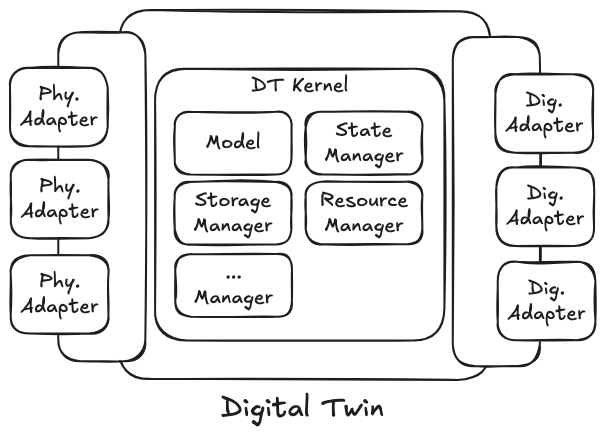
As illustrated in the updated architecture diagram below, the Digital Twin now has a clearer hierarchical structure with the DT Kernel serving as the central orchestrator managing core components including the Model (behavioral logic), State Manager, Storage Manager, Resource Manager, and optional extension managers.
The key architectural changes are:
DigitalTwinModel → DigitalTwinKernel: The core orchestrator has been renamed to accurately reflect its role as the fundamental nucleus coordinating all DT componentsShadowingFunction → DigitalTwinModel: The behavioral definition component now properly claims the “Model” terminology, representing the actual logic that defines how the Digital Twin behavesThe following subsections detail each architectural change, explaining the rationale, implementation specifics, and developer-facing implications.
The previous class DigitalTwinModel has been renamed to DigitalTwinKernel to better reflect its actual architectural role and responsibilities.
The former name “Model” was misleading, as this class does not represent the Digital Twin’s behavioral model but rather serves as the central orchestrator of the DT’s core functionalities. The new name accurately conveys its role as the fundamental nucleus of the Digital Twin architecture.
The DigitalTwinKernel is an internal class that coordinates and manages references to the central components shared across different Digital Twin modules:
DigitalTwinStateManager: Manages the canonical state representation of the Digital TwinDigitalTwinModel (formerly ShadowingFunction): Defines the behavioral model and shadowing logic of the Digital TwinStorageManager: Handles persistence and retrieval of DT state, events, and lifecycle dataResourceManager: Manages DT resources and their lifecyclesAugmentationManager (optional): Orchestrates augmentation functions to extend DT capabilitiesAs part of this architectural clarification, the ShadowingFunction class has been refactored and renamed to DigitalTwinModel properly claiming both the “Model” terminology for the component that actually defines the Digital Twin’s behaviour through the implementation of Shadowing Function(s) to react to physical and digital events.
From the Developer point of view the main change is the naming convention but from a method implementation nothing is changed. The definition of a DigitalTwinModel class is the same of the previous called ShadowingFunction as illustrated below:
import it.wldt.adapter.digital.event.DigitalActionWldtEvent;
import it.wldt.adapter.physical.PhysicalAssetDescription;
import it.wldt.adapter.physical.event.PhysicalAssetEventWldtEvent;
import it.wldt.adapter.physical.event.PhysicalAssetPropertyWldtEvent;
import it.wldt.adapter.physical.event.PhysicalAssetRelationshipInstanceCreatedWldtEvent;
import it.wldt.adapter.physical.event.PhysicalAssetRelationshipInstanceDeletedWldtEvent;
import it.wldt.core.model.DigitalTwinModel;
import java.util.Map;

public class TestDigitalTwinModel extends DigitalTwinModel {

    public TestDigitalTwinModel(String id) {        super(id);    }
    //// Shadowing Function Management Callbacks ////
    @Override    protected void onCreate() {
    }
    @Override    protected void onStart() {
    }
    @Override    protected void onStop() {
    }

	// ========================================
	// Digital Twin LifeCycle CALLBACKS
	// ========================================
	// The following abstract methods allow the Digital Twin Model to shape its behaviour with respect to the evolution of the instance life cycle through its different phases.

    //// Bound LifeCycle State Management Callbacks ////
    @Override    protected void onDigitalTwinBound(Map<String, PhysicalAssetDescription> adaptersPhysicalAssetDescriptionMap) {
    }
    @Override    protected void onDigitalTwinUnBound(Map<String, PhysicalAssetDescription> map, String s) {
    }
    @Override    protected void onPhysicalAdapterBidingUpdate(String s, PhysicalAssetDescription physicalAssetDescription) {
    }

    // ========================================
	// SHADOWING FUNCTION CALLBACKS
	// ========================================
	// The following methods define the shadowing behavior of the Digital Twin.

    //// Physical Property Variation Callback ////
    @Override    protected void onPhysicalAssetPropertyVariation(PhysicalAssetPropertyWldtEvent<?> physicalAssetPropertyWldtEvent) {
    }
    //// Physical Event Notification Callback ////
    @Override    protected void onPhysicalAssetEventNotification(PhysicalAssetEventWldtEvent<?> physicalAssetEventWldtEvent) {
    }
    //// Physical Relationships Notification Callbacks ////
    @Override    protected void onPhysicalAssetRelationshipEstablished(PhysicalAssetRelationshipInstanceCreatedWldtEvent<?> physicalAssetRelationshipInstanceCreatedWldtEvent) {
    }
    @Override    protected void onPhysicalAssetRelationshipDeleted(PhysicalAssetRelationshipInstanceDeletedWldtEvent<?> physicalAssetRelationshipInstanceDeletedWldtEvent) {
    }
    //// Digital Action Received Callbacks ////
    @Override    protected void onDigitalActionEvent(DigitalActionWldtEvent<?> digitalActionWldtEvent) {
    }}
After defining the DigitalTwinModel, you can instantiate the Digital Twin with a clearer constructor signature that emphasizes the Model as the core behavioral component, with shadowing functions implemented internally through dedicated callback methods:
// Create the new Digital Twin with its Shadowing Function
DigitalTwin digitalTwin = new DigitalTwin("dt-demo-001", new TestDigitalTwinModel("my-dt-model"));

// Physical Adapter with Configuration
digitalTwin.addPhysicalAdapter(
        new DemoPhysicalAdapter(
                String.format("%s-%s", digitalTwinId, "test-physical-adapter"),
                new DemoPhysicalAdapterConfiguration(),
                true));

// Digital Adapter with Configuration
digitalTwin.addDigitalAdapter(
        new DemoDigitalAdapter(
                String.format("%s-%s", digitalTwinId, "test-digital-adapter"),
                new DemoDigitalAdapterConfiguration())
);
Then we can add the Digital Twin to the Engine for the execution:
// Create the Digital Twin Engine
DigitalTwinEngine digitalTwinEngine = new DigitalTwinEngine();

// Add the Digital Twin to the Engine
digitalTwinEngine.addDigitalTwin(digitalTwin);

// Start all the DTs registered on the engine
digitalTwinEngine.startAll();
Introduced formal annotations for Digital Twin Shadowing Function methods to provide machine-readable metadata and enable advanced tooling capabilities.
New Components:
@ShadowingFunction annotation - Marks methods as shadowing function callbacks with type categorizationShadowingType enum - Defines shadowing operation categories (physical variations, digital actions)Benefits:
Developer Impact:
Example:
@ShadowingFunction(
    value = ShadowingType.PHYSICAL_PROPERTY_VARIATION,
    description = "Updates temperature state when sensor reports new values"
)
protected void onPhysicalAssetPropertyVariation(PhysicalAssetPropertyWldtEvent<?> event) {
    // Implementation
}
Digital Twin State Event Notifications were correctly persisted to the WLDT Storage layer but were inaccessible through the Query System in previous versions. This gap prevented users from querying historical state event notifications, significantly limiting:
The Query System now fully supports retrieval of Digital Twin State Event Notifications with comprehensive query capabilities. Modified Components includes
QueryResourceType EnumDIGITAL_TWIN_STATE_EVENT_NOTIFICATION resource typeQueryManager InterfacehandleStateEventNotificationQuery()DefaultQueryManager ImplementationhandleStateEventNotificationQuery()StorageQueryTester Test ClasstestSyncStateEventNotificationRangeQueries()Digital Twin State Event Notifications can now be queried using three query strategies:
| Query Type | Description |
|---|---|
TIME_RANGE | Retrieve notifications within a specified time window |
SAMPLE_RANGE | Retrieve a specific range of notification samples by index |
COUNT | Retrieve the most recent N notifications |
No breaking changes. Existing code continues to work unchanged. Applications can immediately begin querying historical state event notifications using the new DIGITAL_TWIN_STATE_EVENT_NOTIFICATION resource type. Markdown documentation has been also updated to be aligned with the new release.
Physical Adapters can now receive and react to Digital Twin lifecycle events, enabling adaptive behavior based on synchronization state changes. While Digital Adapters have always received lifecycle updates to notify external observers and implement protocol-specific behavior, this capability was missing on the Physical side of the Digital Twin architecture. Physical Adapters can benefit from lifecycle awareness to:
The base PhysicalAdapter class now implements the LifeCycleListener interface, receiving notifications about Digital Twin lifecycle evolution.
Since Physical Adapters are not interested in all lifecycle variations, the PhysicalAdapter base class internally manages the full LifeCycleListener callback set and exposes only two relevant methods for developer override:
public void onDigitalTwinSync() {
    // Method intentionally left blank
    // Override in subclasses to handle synchronization events
}

public void onDigitalTwinUnSync() {
    // Method intentionally left blank
    // Override in subclasses to handle out-of-sync events
}
The Digital Twin State is intentionally excluded from both method signatures. Physical Adapters should remain decoupled from the DT’s computed state representation, maintaining clear architectural boundaries.
Other LifeCycleListener callbacks are not exposed to Physical Adapters because:
Existing Physical Adapter implementations require no changes—the new callbacks have empty default implementations. Developers can opt-in by overriding onDigitalTwinSync() and/or onDigitalTwinUnSync() when lifecycle-aware behavior is needed.
This enhancement resolves Issue #25 (GitHub Link), which addresses a critical ambiguity problem in multi-adapter Digital Twin configurations.
When multiple Physical Adapters publish variations to the physical world using identical keys (e.g., two adapters both reporting a temperature property), the DigitalTwinModel cannot distinguish the source adapter of each variation. This ambiguity prevents:
Example Scenario:
Physical Adapter A (Internal Sensor) → temperature: 22.5°C
Physical Adapter B (External Sensor) → temperature: 18.3°C

Problem: Both variations have key "temperature" - which is which?
Solution
Physical asset events now include automatic source identification through the originating Physical Adapter ID.
The PhysicalAssetWldtEvent class has been enhanced with a new physicalAdapterId field that identifies the source adapter for every event. This field is automatically populated by the framework—no developer action required.
Mechanism:
publishPhysicalAssetPropertyWldtEvent(), publishPhysicalAssetEventWldtEvent(), publishPhysicalAssetRelationshipCreatedWldtEvent(), publishPhysicalAssetRelationshipDeletedWldtEvent()setPhysicalAdapterId(String physicalAdapterId) before event propagationDigitalTwinModel and in generale physical events subscribers receive events with full source contextAdded contentType (String) field to the PhysicalAssetEvent class to allow adapters to communicate
the content type of the physical event body (e.g. application/json).
The field is fully accessible via getter and setter methods.
With this change the PhysicalAssetEvent now includes the following fields:
type: Domain specific event type (e.g., “temperatureAlert”, “motionDetected”) that the developer can define based on the physical event semantics maybe with the support of a common ontology or taxonomy.contentType: The content type of the event body (e.g., “application/json”, “text/plain”) that allows the receiving Digital Twin Model to correctly interpret the event payload.